Subscribe
Tag

Golang

23 posts

LLM

Why a 1B Ollama model failed as a trading risk gate

I tried to turn llama3.2:1b into a pre-trade rule checker with an Ollama Modelfile. It passed 2 of 6 test cases, invented a margin check and said 174 is under 45. Here is the setup, the eval script and what I use instead.
7 min read

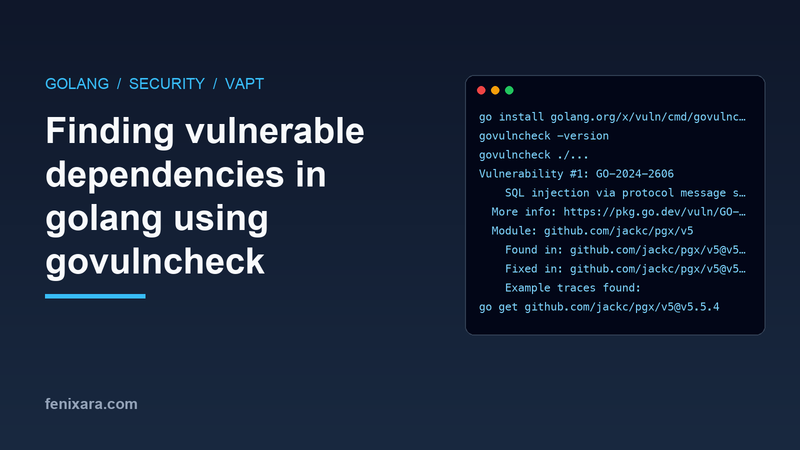
Finding vulnerable dependencies in golang using govulncheck

govulncheck only reports vulnerabilities your code can actually reach, which makes the output short enough to act on. Here is how I run it, why I scan the built binary and how a fixed vulnerability came back because of the Go version in go.mod.

4 min read

Unleashing the Power of GraphQL with Golang

GraphQL, without a doubt, has emerged as a truly transformative force in the constantly evolving API development landscape. It grants developers the remarkable ability to create data retrieval interfaces that are not only flexible but also incredibly efficient. And when it comes to harnessing the full power of GraphQL, there

3 min read

Naming Conventions in Golang: A Comprehensive Guide

In the realm of software development, naming conventions play a crucial role in enhancing code readability, maintainability, and consistency. Well-defined naming conventions ensure that code is self-explanatory, reducing the cognitive load for developers and promoting collaboration. Golang, a popular programming language, adheres to a set of established naming

2 min read

Writing Idiomatic Golang Code

Idiomatic Golang code is code that follows the established conventions and best practices of the Golang community. It is characterized by its simplicity, readability, and maintainability. Writing idiomatic Golang code not only improves the quality of your code but also makes it easier for others to understand and contribute to.

2 min read

Indentation and Formatting in Golang

Indentation and formatting are essential aspects of writing clean and readable Golang code. Consistent indentation makes the code easier to understand and maintain, while proper formatting improves code readability and highlights important code structures. Indentation Indentation is the practice of adding spaces or tabs to the beginning of lines of

3 min read

Creating a Multi-Stage Dockerfile for a GoLang Web Service

Multi-stage Dockerfiles are a powerful technique for building efficient and lightweight Docker images. By utilizing multiple stages in a single Dockerfile, developers can separate the build process from the runtime environment, resulting in a smaller and more streamlined image. Benefits of Multi-Stage Dockerfiles 1. Smaller Image Size: Multi-

1 min read

Organizing a Large-Scale Gin-GORM Web Service: A Guide to Effective Folder Structure

Developing large-scale web services demands a well-structured and organized codebase to ensure maintainability, scalability, and ease of collaboration. When utilizing the Gin framework and GORM ORM for web service development, a carefully designed folder structure becomes crucial for managing the complexity of a growing project. Principles of Effective

2 min read

Building Modern Web Services with GoLang, Gin, and GORM: A Practical Guide

Harnessing GoLang for Web Service Development: Building Efficient and Scalable APIs In the dynamic landscape of software development, web services have emerged as essential tools for enabling seamless communication and data exchange between applications. GoLang, a rapidly growing programming language, has gained prominence in web service development due to its

4 min read

Golang Tutorial 8: Concurrency in GoLang

Concurrency is a fundamental programming paradigm that allows multiple tasks to execute simultaneously, enabling efficient utilization of resources and improved program responsiveness. GoLang provides a powerful set of tools and mechanisms for achieving concurrency, making it an ideal language for developing high-performance and scalable applications. Understanding Concurrency and Parallelism

3 min read

Golang Tutorial 7: Structures in GoLang

Structures, also known as structs, are fundamental data types in GoLang, providing a mechanism for grouping related data items into a single unit. They allow developers to create custom data types that encapsulate specific attributes and behaviors, promoting code organization, data integrity, and modularity. By effectively utilizing structs, GoLang developers

2 min read